Japan and the west have undergone a process of globalization that has shaped both cultures in both positive and negative ways. The west which has for the most part become a conglomeration of different cultures has lost any semblance of a succinct cultural identity. Japan has a longer history than the west and has developed its own unique culture, recently adapting a host of western influences following World War II. Japan’s move toward “modernization” has created a Japan that has more noticeable western influences built into the cultural framework than ever before (Tobin, 57). However, these influences are also ever present within western societies. Because western societies are such a conglomeration of other cultures, cultural borrowing in the west is less noticeable when compared to Japan which has developed its own unique culture over hundreds of years. Images of 21st century America provide a host of evidence that support the ever present balance of the cultural exchange between the west and Japan.
Following World War II Japan embarked on a path towards “modernization” that involved the adaptation of a host of western values, these western values significantly transformed Japanese culture. Japan became heavily entrenched in the market of selling to the world, in industries such as electronics. With such cultural exchange came not only the outsourcing of Japanese culture but also an introduction of outside cultural influences to Japan. For example, the spread of Japanese electronic products to the west, such as the radio, allowed for Japanese name brands to develop a positive name in the late 1950’s (Overfield, 380). As a result, Japan’s market opened up to the west. In the 21st century chains such as McDonalds, KFC, and Starbucks have become a familiar part of Japanese society and have even developed chains mimicking their services. For example, the Japanese chain MosBurger has gained great popularity in Japan capitalizing off of the American idea of the hamburger, yet making it inherently Japanese (Tobin, 27.)

Although Japan has absorbed western culture through its adaptation of food chains such as McDonalds, KFC, and Starbucks it is created a culture that has developed from these chains that has become uniquely Japanese. For example, the MosBurger franchise has created additions to the standard burger and created a “riceburger” that instead of using a bun made from bread, substitutes the bread with grilled rice pressed into the shape of a bun (Tobin, 27). Also, items on the MosBurger menu contain food items foreign to most western burger menus. The MosBurger menu includes the shrimp burger, a burger one is not likely to fine in the west but that is extremely popular in Japan.
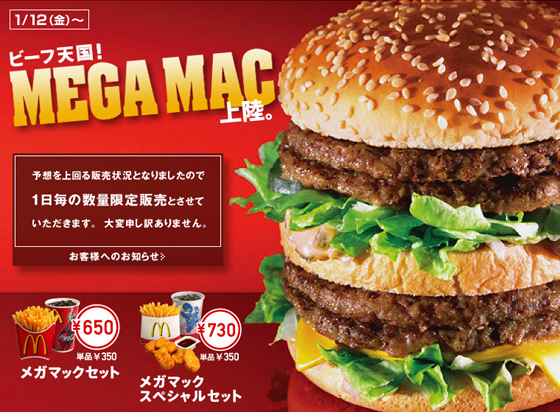
McDonalds is another franchise which has suffered the same instrumental changes to its menu ascribed to the MosBurger franchise. McDonalds has developed the Mega Mac which is a product of Japan but had not been released in the west. Although Americans are known for their large food consumption and obese population, they are not allowed the pleasure of experiencing the taste of a burger with 4 beef patties. The Mega Mac is instead issued exclusively in Japan, and as a result it develops the image of being uniquely Japanese. Because the western McDonalds chain are denied the production of this burger only tourists from the west become aware of its existence and upon returning home associate the Mega Mac with Japanese culture. Conversely, tourists from Japan can still associate the large portions served at McDonalds chains in the U.S. with American culture. Although one has the opportunity to purchase a larger Big Mac in Japan, the overall portion size in Japan is still smaller than in the U.S. and so the two chains both ascribe unique images of the two cultures to their products.
Consequently, Japan is not a culture that is “westernizing” or becoming “modernized” due to the cultural change it is undergoing as a result of its trade with other world cultures. Rather, Japanese culture is undergoing the process of globalization whereby cultures are increasingly becoming more similar to one another than ever before. In Re-Made in Japan, Joseph J. Tobin posits an argument that tries to avoid seeing contemporary Japanese consumer behavior and domestic life, including the domestication of the west, as either a universal story or a unique process (Tobin, 6). Instead Tobin tries to find a middle ground and posits an argument that suggests there is an even distribution of cultural exchange between the west and Japan. For example Tobin argues the Japanese advertising industry plays a key role in the contemporary merchandising of the west (Tobin, 15). Tobin argues western models and celebrities are paid large sums of money to appear on Japanese ads and help sell products associated with the west (Tobin, 15). However, the west also indulges in many overtly Japanese cultural objects. Wood-block prints which developed during the Meiji era in Japan became a great popular item amongst many Americans interested in “exotic” Japanese works (Tobin, 30).
Also exemplary of the two-way cultural exchange between the west and Japan developed in the late 1950’s with the creation of the Sony cooperation. The Sony cooperation developed at a time when names with a “made in Japan” logo signified to Americans the mark of a cheap product. As a result the engineers behind the Sony cooperation decided to develop a brand name that was not suggestive of a Japanese company, so as to trick American buyers into believing they were buying a product that was not Japanese (Overfield, 381). Sony wanted to prove the quality of their product before the American public could judge them; furthermore they wanted to also enhance the reputation of the Japanese brand name following the acceptance of their electronic products under the name of Sony (Overfield 381). After Sony’s success in bypassing their brand conscious target audience they eventually developed a well respected name not only in Japan but throughout the U.S. In fact, today Sony is one of the world’s largest media conglomerates (Wikipedia). Many of the high-quality electronic products Americans enjoy, beginning with the “pocketable” transistorized radio in 1951 are a result of the cross culture trade between Japan and the west that has allowed for Japanese products to infiltrate the American market and create loyal followers of a Japanese brand. Therefore, Tobin’s argument is well supported as it becomes clear that there is a middle ground in terms of Japans relation with the west. The two cultures have forever been trading with one another and interchanging cultures, before these two cultures were trading amongst one another they were trading with other world cultures.
Another aspect of both Japanese and western cultures that help add to the cultural exchange between the two regions are the ever present influence of cities in shaping the lifestyle’s of these regions people. Shunsuke Tsurumi argues in A Cultural History of Post War Japan that high industrialization has made Japan a prosperous country to the envy of other nations (Tsurumi, 120). Tsurumi further argues Japan has to a large extent become urbanized and a large majority of the population has become city dwellers (Tsurumi, 120). Such characteristics are perfect for foreign products to reach the Japanese population. However in Japan’s countryside there is often a rejection of western practices. For example, in rural Hokkaido rural elders’ remove from western practices completely (Tobin, 16). Also, because of the lower incomes of Japanese in rural area’s it is harder for these individuals to purchase goods that Japanese living in urban areas can afford. Therefore, the urban market is a prime target for cross cultural exchange not only amongst Japanese but in the west as well.


As a result, cities become prime targets for conglomerates to transform the visual associations of commercial franchises. For example, images of KFC’s Colonel Sanders vary across Japan. The Colonel is depicted not only in his standard garb but also in a Kimono and what those in the west would refer to as “Samurai” garb. The image of the Colonel then becomes somewhat complex as it is no longer inherently American, but now the image has become Japanese. The addition of a Japanese Kimono for instance, removes the Colonel from the western garb he usually wears and suggests he has become Japanese. However, this image is made complex as the Colonel is depicted carrying a watermelon while in a Kimono. Therefore, there is a clash of images as the Colonel is Japanese while embracing western food. This image is in many ways reminiscent of the Colonels association with Japan because although the franchise has moved to Japan it has still maintained its western food menu and aura.
Also, adding to the new image of the Colonel that makes KFC somewhat more marketable in Japan is evident in the change of the models garb so as to remove the viewers gaze from the original logo of the Colonel. The Colonel’s outside of the KFC in both pictures are both very extravagant, and have been transformed to meet the visual needs of a Japanese audience. For example, the Colonel in the Samurai garb is adorned in multi-color armor that is far from a realistic depiction of armor. Furthermore, this armor also appears to be rounded on the edges making the image one that is cute, rather than scary. The roundness of the Colonels features in accordance with the playful colors makes the image of the Colonel cute and the idea of eating at KFC even more appealing to the Japanese customer that cherishes the cute image.
Although the image of the Colonel has been altered in both of these models to make them more Japanese the image of the original Colonel is still placed on the entrance to the KFC franchise. This image is not cute, and the colors used to compose the image are extremely bland. These two images used together may serve two purposes; the model of the Colonel may attract new Japanese customers while the familiar Colonel on the entrance to the KFC serves as a magnet for tourists seeking a meal reminding them of home. In this way globalization allows for these franchises to cater to diverse audiences. Furthermore this situation is also evidence of the city’s ability to create a target audience for itself. Models of the Colonel would look out of place in rural neighborhoods whereas in an urban environment they do not stand out and are more accepted by the public. This is also to be expected as Tobin argues urban dwellers are more acceptant of western ideas than those in rural areas.
Also adding to the cultural exchange between Japan and the west is the influence of the “exotic.” For westerners the “exotic” often implies something abnormal and to be taken in small portions. For example, food from Japan may be classified as exotic while electronics are not. In Japan Depato stores were originally seen as western and exotic because they were originally displays for Western imports the Japanese were eager to see and buy (Tobin, 43). However, these Depato stores have made foreign customs, ideas, and merchandise familiar by giving them meanings consistent with Japanese cultural practice (Tobin, 43). The same process occurs in western culture, evidence of this is the acceptance of eating Sushi. Eating Sushi and Japanese restaurants have become so accepted in western culture that the practice is no longer foreign, it is simply “exotic” and widely culturally accepted in the western world. As the west becomes more exposed to Japanese culture images such as this become more widely accepted. The same can be said of the west as of Japan that often cities are more exposed to cultural exchange than rural areas and are often therefore more accepting of cultural exchange than other regions of the west.
Also evidence of this cultural exchange in Japan are the advances the Japanese have made in enhancing the once western toilet. In Japan there are distinctions made between the traditional Japanese toilet and what is referred to as the western toilet. However, the western toilet referred to in Japan often has amenities those in the west are unaccustomed to. These amenities include heated seats and functions that help one clean themselves by pressing a button. In In Praise of Shadows, Tanizaki Junichiro deconstructs the differences between western culture and Japan. One of the most stark differences surfaces in the bathroom where there are two different living environments aspired by the Japanese and the west. While the Japanese enjoy more dark environments with subtle tones the west are in favor of incorporating white tiles in their bathrooms and making them as bright as possible (Tanizaki, 28). Therefore the two contrasting images of toilets are interesting not only because one is western and one is Japanese, but also because of the color scheme of the bathroom as well as the materials used in these two bathrooms. Whereas the Japanese bathroom utilizes marble to construct the platform surrounding the actual toilet, the western style bathroom does line the walls with plain white tiles. While the Japanese find beauty in the light and darkness surrounding the bathroom, western culture finds beauty in the thing itself and therefore cannot imagine a beautiful bathroom since using the toilet in western eyes is anything but beautiful (Tanizaki, 30).
Furthermore, the evolving culture of Japan is constantly incorporating not only western cultures but cultures from throughout the world to creating a unique Japanese culture. In The Super Flat Manifesto Murakami Takashi tackles the idea of “super flatness” and its relation to Japan. Murakami argues “Super flatness” is an original concept of Japanese who have been completely westernized (Takashi, 216). Takashi argues the idea of super flat is similar to the moment where the layers of Japanese culture, erotic pop, otaku, and H.I.S.ism, fuse into one (Takashi, 216). This relationship holds true with the images analyzed thus far. In the first image of Colonel Sanders outside of two different KFC restaurants both figures have been slightly altered to appeal to a Japanese audience, yet the food offered inside the two restaurants are uniquely western. Through the re-invention of the Colonel and his clothing Japan altered the image of the Colonel to meet Japanese tastes and thus contributed to the idea of super flat by creating a KFC so engrained in Japanese culture it is hard to separate the actual KFC chain from Japan and make it completely western.
Although Japan has borrowed a host of cultural influences from the west its culture is more complex than many are led to believe. Tobin argues before Japan borrowed cultural practices from the west it borrowed from China (Tobin, 33). Such influences included written and spoken language among other influences. However, this exchange was mutual as China also had and continues to have much it can borrow, not only materially but culturally as well, from Japan. Additionally, although the Japanese did borrow language patterns similar to Chinese from China, these additions to the Japanese language do not receive as much criticism as the Japanese adaptations of western vocabulary. Tobin creates a category for the Japanese adaptation of western vocabulary and titles these words “loan words” (Tobin, 71). Many of these words have similar pronunciations in Japanese as in English and are words the Japanese have taken from English and simply written in Japanese but kept their English sounds (Tobin, 71). Although the Japanese have borrowed some of the words in their language from English and Chinese respectively, the same attention is not paid to the English language which is also a compilation of what could also be termed “loan words.”
English has many roots in Latin and also borrows heavily from the French language. Words such as “century” and “resume” are proof of the English languages ability to borrow words from other cultures. However, because the west has grounded itself since its induction in a plethora of different cultures merging into one it has been able build an identity for itself that is unique and does not draw attention when borrowing from other cultures. Conversely, Japanese culture is more homogenous and therefore is more prone to criticism when it borrows from other cultures. Within Japanese society this is simply more noticeable.
Japanese society is increasingly becoming a conglomeration of different cultures merging into one, though not as overtly obvious as in the west. The toilet is the perfect example of western and Japanese cultures merging together silently. The Japanese before their introduction to the western toilet had one of their own, however once the Japanese had the model for a western toilet they were able to improve on this model and make it inherently Japanese. Such changes began early in Japanese history as they began to make moves towards “modernization” following World War II. Thus, there developed a Japan increasingly borrowing cultural pointers from outside of its borders and exporting its cultural values outside of its borders as well. Aside from the toilet, Tsurumi notes in 1960 Japan began to shift the incomes of its agricultural families with much of their income coming mainly from industry (Tsurumi, 119). Also, as earlier mentioned the Japanese were finding markets abroad and targeting electronic products at a world market. Additionally, since the 1960’s Japan also developed a culture influenced by other cultures. Evidence of this cultural shift included the infiltration of western melodies in Japan (Tsurumi, 79). Furthermore after 1960 foods from before World War II began to become nostalgic and were not enjoyed daily (Tsurumi, 119). These drastic changes in culture developed the foundation on which Japan could begin to develop itself into a culture that developed as a result of its influences from cultures outside of its own.
Evidence of the cultural acceptance of foreign culture entering both the west and Japan are evident on common food chain websites. For example, the Starbucks homepage in Japan has a similar layout and color scheme to the one in the U.S. The cultural acceptance of Starbucks may not be as high in Japan, hence the lack of work in designing a site meant to directly cater to the needs of a Japanese consumer base. However, when one compares the Japanese and American McDonald websites the differences are glaring. The Japanese McDonalds website is much more cluttered and uses brighter more vibrant colors than the site from the U.S. Also, the Japanese site incorporates a mixture of English and Japanese texts, making this a multi-lingual site (http://www.mcdonalds.com/). However, advertisements that are obviously Japanese include English text suggesting the cultural integration of English into the Japanese society (http://www.mcdonalds.co.jp/). The English on the McDonalds site is English that gives the impression it is suppose to be cool. Through the McDonalds website McDonalds is portrayed not only with being cute, through the beautiful colors and animated burgers laid throughout the site, but also cool through the incorporation of sporadically placed English words.
Through the layout of the McDonalds website it is clear McDonalds has been well integrated into Japanese culture and no the surface separated itself from its western counterparts, however this is simply a result of globalization and makes Japan no different than the tactics of the west to incorporate other cultures in the same manner. The west is guilty for adopting restaurants such as Au Bon Pain. An eatery with a name that obviously is not English, but many Americans have become familiar with and incorporated into the culture. For Americans living in the city this is a great food location to visit while in the midst of a hectic day in the city, for those outside of the city this many not be a familiar name. Yet, both McDonalds and Au Bon Pain speak to the acceptance of cultural exchange that has developed amongst the west and Japan.
In conclusion, images from Japan and the west are exemplary of the cultural exchange that has been developing in these two regions for the past 100 years in great speed. Often Japan is criticized for becoming too western, when in fact it is adapting western culture, and other cultures as well, to its cultural framework and making it its own. This adaptation is no different than the techniques other cultures use to perform the same task. The west is the perfect example of this as it is a conglomeration of different cultures fused into one, however because it does not have the same homogeneous background as Japan does not receive the same criticism or recognition when it borrows from other cultures. There is an even exchange of cultures between the west and Japan, Japan is not “westernizing” and the west is not becoming “Japanese.”After World War II Japan continues to develop a culture that is becoming ever more diverse. Japan continues to exchange its culture with other cultures worldwide and is creating what may be termed a hybrid Japan, or a Japan borrowing from other cultures and enhancing these cultural tenets to better fit their societal needs while exporting their cultural traditions outside of Japan.
Works Cited
"[ HISTORY ]." MOS BURGER. 14 May 2009
Junichiro, Tanizaki. In Praise of Shadows. Leete’s Island Books: 1977.
Overfield, James H. Sources of Twentieth-Century Global History, (Boston: Houghton Mifflin, 2002).
Shunsuke, Tsurumi. Cultural history of postwar Japan, 1945-1980. London: KPI, Distributed by Methuen, 1987.
"Sony -." Wikipedia, the free encyclopedia. 14 May 2009
Starbucks Coffee Company. 14 May 2009
Starbucks Coffee Japan -. 14 May 2009
Takashi, Murakami. The Super Flat Manifesto (2000).
Tobin, Joseph J. Re-made in Japan everyday life and consumer taste in a changing society. New Haven: Yale UP, 1992.
United States. 14 May 2009
Welcome to McDonald's Japan. 14 May 2009

No comments:
Post a Comment